
School cleaning services in Jacksonville: what parents and administrators should know

School cleaning in Jacksonville covers daily classroom and restroom sanitation, cafeteria cleaning, floor care, and disinfection protocols guided by CDC standards. Parents can use this to check what a school’s cleaning program should actually include. Administrators can use it to vet a provider on licensing, protocols, and documentation before signing a contract.


Key Takeaways

  • School cleaning covers classrooms, restrooms, cafeterias, gyms, and admin areas, not just trash and floors
  • Restrooms and high-touch surfaces need daily attention
  • Deep cleans like carpet extraction and floor waxing run during school breaks
  • CDC guidance separates cleaning, sanitizing, and disinfecting, and each one serves a different purpose
  • School cleaning in Jacksonville typically runs $0.08 to $0.20 per square foot per month
  • Call ET Janitorial Services at (904) 666-0023 for a facility walkthrough and quote.

Table of Contents

      1: What are school cleaning services?

      2: What does a professional school cleaning service include?

      3: How often should a school be cleaned?

      4: What cleaning standards and guidelines apply to schools?

      5: How much does school cleaning cost in Jacksonville?

      6: What should parents know about their school’s cleaning program?

      7: What should administrators look for when choosing a school cleaning company?

      8: How does Jacksonville’s climate affect school cleaning?

      9: The bottom line

      10: Get a free school cleaning quote in Jacksonville

      11: FAQ


What are school cleaning services?

School cleaning services are commercial janitorial programs built for the traffic, health rules, and shared-surface risks of an educational facility. They cover the same core tasks as commercial cleaning.

The difference is frequency and product standards, since children are in the building all day. A school moves hundreds of people through the same hallways, restrooms, and cafeteria every day.

That volume of traffic wears down floors faster than a typical office. It also spreads germs faster.

Jacksonville schools range from small private campuses to large public high schools. The cleaning demand scales with the building, but the core service categories stay the same.


What does a professional school cleaning service include?

A professional school cleaning service covers five core areas: classrooms, restrooms, cafeterias, gyms and locker rooms, and administrative spaces. Each area has its own cleaning priority and product requirements.

Area

What it typically includes

Classrooms

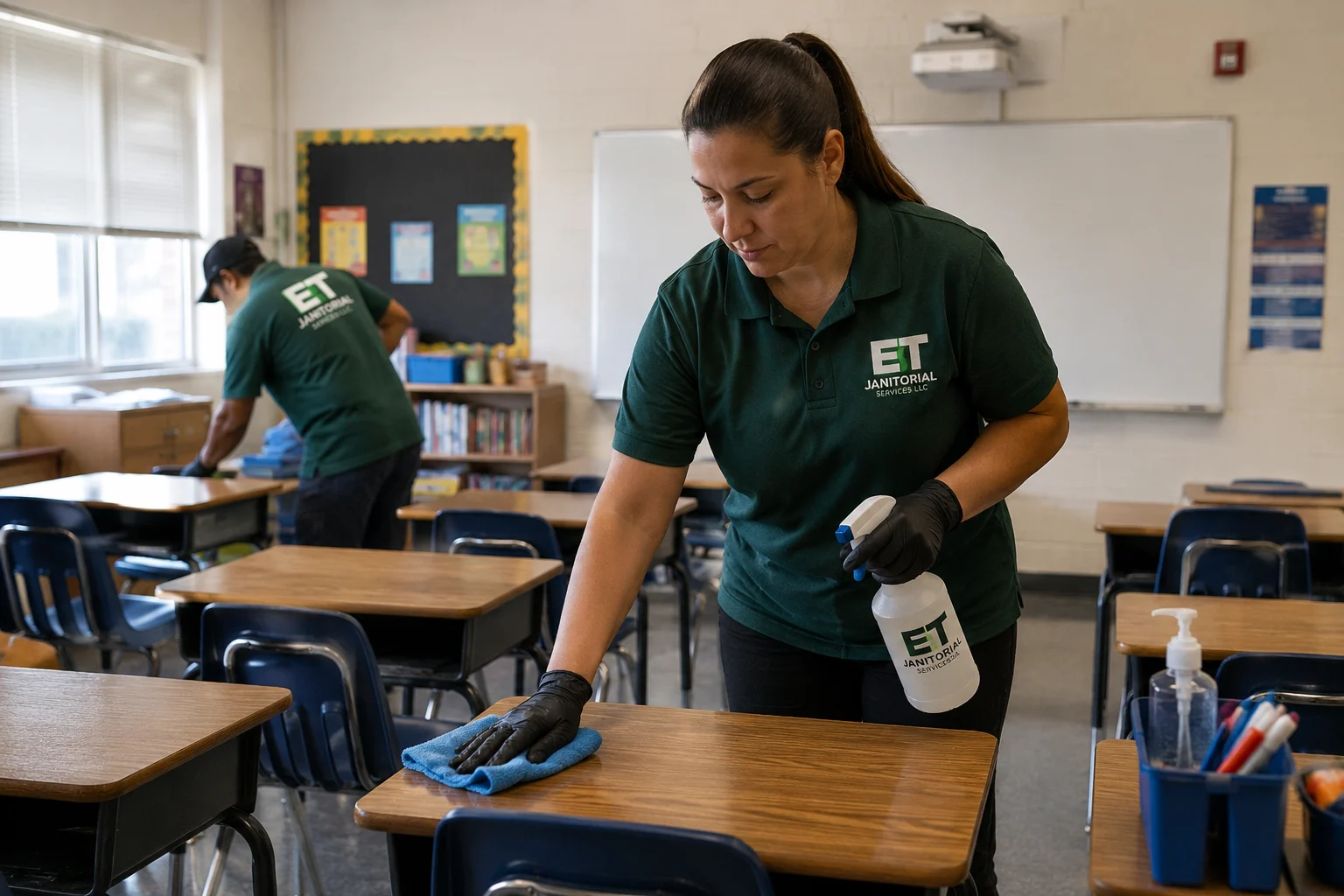
Desk and surface wiping, floor care, trash removal, disinfecting high-touch points like door handles and light switches

Restrooms

Daily sanitation of toilets, sinks, and fixtures, supply restocking, odor control

Cafeteria

Table and seating sanitation, floor cleaning, trash removal, food-safe surface cleaning

Gym and locker rooms

Floor care, mat and equipment surface cleaning, odor control, restroom sanitation

Administrative areas

Dusting, vacuuming, glass cleaning, trash removal, entryway upkeep

Floor care is one of the most overlooked line items in a school contract. Hallway and gym floors take heavy daily wear from foot traffic.

Most schools need periodic floor scrubbing and waxing on top of daily sweeping and mopping. Without it, tile and gym flooring dull faster and can become a slip hazard.

Carpeted classrooms, libraries, and reading areas need separate attention too. Deep cleaning services like carpet extraction and floor stripping usually happen during school breaks, since they take longer and work best in an empty building.


How often should a school be cleaned?

Most schools need daily cleaning of classrooms, restrooms, and high-touch surfaces. Deeper cleaning gets scheduled weekly or during school breaks.

Restrooms in particular should be cleaned at least once daily. High-traffic buildings often need more.

Daily service typically covers trash removal, restroom sanitation, cafeteria cleanup, and surface disinfection in classrooms. This is the baseline that keeps a building from feeling worn down by Friday.

Weekly service covers tasks that don’t need daily attention but still can’t be skipped: floor scrubbing, detailed dusting, and window cleaning. Deep cleaning, including carpet extraction and floor waxing, usually happens during winter break, spring break, or summer.

That timing matters because it lets crews work in an empty building without disrupting classes. The right frequency still depends on student population and building age.

A high-traffic elementary school with younger kids generally needs more frequent restroom and surface disinfection. A smaller administrative building on the same campus needs less.


What cleaning standards and guidelines apply to schools?

School cleaning in Jacksonville should follow CDC guidance that separates cleaning, sanitizing, and disinfecting into three distinct steps. Each one serves a different purpose.

Treating them as the same thing is one of the most common gaps in a weak cleaning program. According to the CDC’s guidance for early care and education settings, cleaning removes germs and dirt using soap and water.

Sanitizing reduces germs to a safe level using a weaker solution. Disinfecting uses a stronger chemical to kill remaining germs on surfaces.

Surfaces should always be cleaned before they’re sanitized or disinfected. Dirt and grime make disinfectants less effective.

On the product side, the EPA’s Safer Choice program certifies cleaners that meet safety standards for human health and the environment. Schools handling young children often specify Safer Choice-certified products for this reason.

A cleaning company that can explain which surfaces get cleaned, sanitized, and disinfected, and why, is showing you a real protocol. That’s different from a marketing claim.


How much does school cleaning cost in Jacksonville?

School cleaning in Jacksonville typically runs $0.08 to $0.20 per square foot per month. That lines up closely with standard commercial cleaning rates in the area.

Facility size, cleaning frequency, and the number of restrooms and food-service areas all move the price. A smaller private school with one cafeteria and a handful of classrooms lands toward the lower end.

A large public school with multiple restrooms, a full cafeteria, and a gym lands higher. Daily disinfection adds to that cost too.

For a broader breakdown of what drives commercial cleaning pricing in this market, our Jacksonville commercial cleaning cost guide covers the same cost factors in more depth. A facility walkthrough is still the fastest way to get an exact number.

Layout and current condition affect price as much as square footage does.


What should parents know about their school’s cleaning program?

Parents don’t need insider knowledge to check whether a school’s cleaning program is doing its job. A few direct questions tell you more than a walk through a clean-looking hallway ever will.

Ask how often restrooms are cleaned during the school day, not just at the end of it. A restroom that’s only serviced overnight can look fine at 8 AM and be in rough shape by 2 PM in a building with hundreds of students.

Ask whether the school uses child-safe, EPA-certified products. This matters more in daycare wings and elementary classrooms than in a high school administrative office, since younger kids touch more surfaces.

Cleanliness also connects directly to illness rates. High-touch surfaces like desks, door handles, and shared supplies are where cold and flu germs spread fastest in a classroom.

A program that disinfects those points daily is doing more than keeping the building looking good.


What should administrators look for when choosing a school cleaning company?

Administrators should choose a school cleaning company based on documented protocols, proper licensing and insurance, and a track record with similar facilities. Price alone isn’t a reliable filter.

A provider that can’t explain their process in detail is a provider you’ll be troubleshooting later. In Florida, janitorial and cleaning businesses generally don’t need a special state license to operate.

They should still carry general liability insurance and, ideally, be bonded. Ask directly whether the company is insured and request proof before signing anything.

Background checks matter more for a school contract than almost any other commercial account. Ask whether cleaning staff assigned to your building have been background-checked as standard practice, not just on request.

Local experience counts too. A provider that’s already worked in Jacksonville understands the humidity, the school calendar, and the kind of buildings common in this market.

For a closer look at what separates a strong local provider from a generic national contractor, our guide on choosing a commercial cleaning company in Jacksonville walks through the same vetting questions in more detail.


How does Jacksonville’s climate affect school cleaning?

Jacksonville’s humidity accelerates mold and mildew growth in school restrooms, cafeterias, and HVAC systems. Buildings without strong ventilation feel this the most, especially in older wings.

Restrooms and locker rooms are the areas most exposed to this risk. Moisture, warmth, and heavy use create ideal conditions for mold along grout lines and behind fixtures.

Regular tile and grout attention during routine cleaning helps keep this from building up between deep cleans. Hurricane season runs June through November, which overlaps with most of the school year.

Facilities in flood-prone areas sometimes need storm-prep or post-storm cleanup scheduled separately from routine service. A local provider will already have a plan for this instead of scrambling when a storm warning goes up.


The bottom line

A real school cleaning program in Jacksonville is built around daily attention to restrooms and high-touch surfaces. It also needs a clear separation between cleaning, sanitizing, and disinfecting.

Pricing should reflect actual square footage and frequency, not a flat guess. Parents can check on a program with a few direct questions.

Administrators can vet a provider the same way they’d vet any other vendor handling a building full of kids. ET Janitorial Services has served Jacksonville facilities since 2018, including schools and educational buildings across the area.


Get a free school cleaning quote in Jacksonville

Ready to see what a real school cleaning plan looks like for your facility? Contact our team for a free walkthrough and same-week quote, no obligation.

ET Janitorial Services LLC
3107 Spring Glen Rd Ste 208, Jacksonville, FL 32207
Call: +1 904-666-0023
Find Us On Google Maps: https://maps.app.goo.gl/z493Qx6o9auSXkqu7

FAQ

Q1: How much does it cost to clean a school? 

School cleaning typically runs $0.08 to $0.20 per square foot per month in the Jacksonville area. Facility size, restroom count, and cleaning frequency move the price. A facility walkthrough gives the most accurate number.

Q2: What is a cleaner at a school called? 

School cleaning staff are commonly called custodians or janitors when employed directly by the school. They’re called cleaning technicians when they work for an outside commercial cleaning company like ET Janitorial Services. Outside providers usually bring their own equipment and supplies.

Q3: Do I need a license for a cleaning business in Florida? 

Florida doesn’t require a special state license to operate a commercial cleaning business. A legitimate provider should still carry general liability insurance and, ideally, bonding. Always ask for proof of insurance before signing a contract.

Q4: How often should a school bathroom be cleaned? 

School restrooms should be cleaned at least once daily. High-traffic buildings often need a midday check and touch-up in addition to a full overnight cleaning. Restrooms are one of the fastest areas to show wear during a school day.

Q5: What are the CDC guidelines for school cleaning and disinfecting? 

The CDC separates cleaning, sanitizing, and disinfecting into three distinct steps. Cleaning removes dirt and germs with soap and water. Sanitizing reduces germs to a safe level, and disinfecting kills remaining germs with a stronger product. Surfaces should always be cleaned first.

Q6: What is the 6 to 10 cleaning list?

The “6 to 10” list refers to the highest-priority high-touch surfaces in a classroom. It typically includes desks, door handles, light switches, shared supplies, faucet handles, and shared electronics. Some janitorial teams use it as shorthand to prioritize disinfection when time is limited.
How to Choose a Commercial Cleaning Company in Jacksonville, FL

The right commercial cleaning company in Jacksonville is licensed, bonded, and insured; has documented commercial experience rather than residential only; quotes after a walkthrough instead of over the phone; and can point you to reviews you can independently verify. Here is how to check a provider against each of those four points before you sign anything.


Key Takeaways

  • Janitorial services and commercial cleaning are not the same thing, and knowing which one you actually need changes every question you should ask a provider.
  • Florida law requires non-construction employers with four or more employees to carry workers’ compensation coverage, and the state runs a free public database where you can verify it yourself before signing.
  • A commercial cleaning company or janitorial company that quotes a flat rate over the phone without walking your facility is showing you a red flag, not a convenience.
  • Jacksonville’s year-round humidity and June-to-November hurricane season create vendor requirements that national vetting checklists skip entirely.
  • Month-to-month flexibility usually serves small and mid-size facilities better than a locked multi-year agreement.
  • Certifications like ISSA’s CIMS require third-party assessment and renewal every two years, so ask when a company was last certified, not just whether it is.
  • ET Janitorial Services LLC has served Jacksonville, Riverside, San Marco, Southside, Arlington, and Orange Park since 2018, with a 5.0-star rating across 19 Google reviews.


Table of Contents

  1. What’s the difference between janitorial and commercial cleaning?
  2. How do you verify a commercial cleaning company’s insurance and licensing?
  3. Does the company have real commercial experience across Jacksonville?
  4. How should a provider handle Jacksonville’s climate and hurricane season?
  5. What contract flexibility should you expect from a janitorial company?
  6. How do you verify a company’s reviews are real?
  7. What questions should you ask before signing?
  8. Frequently Ask Questions


What’s the difference between janitorial and commercial cleaning?

Janitorial services cover the recurring, day-to-day upkeep that keeps a facility functioning: emptying trash, restocking restrooms, vacuuming, wiping high-touch surfaces, and mopping. Commercial cleaning refers to the deeper, less frequent work that routine upkeep cannot address on its own: carpet extraction, floor stripping and refinishing, tile and grout restoration, post-construction cleanup, and window washing.

The distinction matters because it changes what you are buying and how it is priced.

 Janitorial servicesCommercial cleaning
FrequencyDaily, nightly, or weeklyQuarterly, semi-annual, or project-based
ScopeRoutine maintenance and upkeepDeep restoration and specialized work
Pricing modelFlat monthly or per-visit ratePer project or per square foot
Example tasksTrash removal, restroom restocking, vacuuming, surface wipe-downStrip and wax, carpet extraction, post-construction cleanup, tile and grout
Contract typeRecurring agreementOne-time or scheduled add-on

Most Jacksonville facilities need both. A provider handling only one leaves you sourcing the other separately, which usually costs more than bundling and creates gaps in accountability when something is missed.


Why this distinction changes what you should ask a provider

If you ask “do you clean offices?” almost every company will say yes. That question tells you nothing. Ask instead which of these two categories their contract actually covers, and what falls outside it.

A provider offering nightly commercial cleaning for Jacksonville businesses may or may not include quarterly floor stripping and waxing in the same agreement. Same with restroom sanitizing and supply restocking, which some companies bill as an add-on rather than a baseline. Getting this in writing up front is the single most effective way to prevent a scope dispute six months in.


How do you verify a commercial cleaning company’s insurance and licensing?

Ask for a current certificate of insurance and verify it independently rather than accepting a claim on a website.

Under Florida law, non-construction employers with four or more employees are required to carry workers’ compensation coverage, according to the Florida Department of Financial Services. That threshold matters directly to you: if an uninsured cleaner is injured on your property, the liability exposure can land on your business rather than theirs.

The Florida Division of Workers’ Compensation maintains a Proof of Coverage database that is open to the public. You can search a company’s coverage status yourself, in a few minutes, without asking the vendor’s permission. Very few facility managers do this, and it is the fastest way to separate companies that carry real coverage from companies that describe themselves as “fully insured” in marketing copy.


What a certificate of insurance should show

A legitimate certificate names your business as a certificate holder, lists the policy period with current dates, and shows general liability coverage limits in actual dollar figures. If the certificate is expired, generic, or missing limits, treat that as disqualifying rather than as a paperwork delay.


Why bonding matters separately from insurance

Insurance covers accidents. Bonding covers dishonesty, specifically theft or property damage caused by an employee. These are different instruments, and a company can carry one without the other. Cleaning crews work in your building after hours, often unsupervised, with access to offices, equipment, and stored records. Ask about both explicitly, because “we’re insured” answers only half the question.


Does the company have real commercial experience across Jacksonville?

A company that primarily cleans homes is not automatically equipped to service a multi-floor office building, a warehouse with loading docks, or a medical suite with infection-control requirements. Volume, equipment, staffing depth, and scheduling logistics are all different at commercial scale.

Ask which Jacksonville-area facilities the provider currently services and in which neighborhoods. Coverage across Riverside, San Marco, Southside, Arlington, and Orange Park is not the same as coverage in one corridor, and a company stretched thin geographically will struggle to keep the same crew on your building.

Certification is another signal worth checking. ISSA’s Cleaning Industry Management Standard (CIMS) requires an independent third-party assessor to verify a company’s management systems, and organizations must re-certify every two years. That renewal cycle is the useful part: ask when the company was last assessed, not simply whether it holds a certificate. A lapsed certification tells you something about how the operation is run today.

Chemical handling is a related area most buyers never ask about. OSHA’s Hazard Communication Standard requires employers with hazardous chemicals in the workplace to maintain safety data sheets and train workers to handle those chemicals appropriately. In a medical office, a daycare, or a commercial kitchen, a crew that cannot explain its chemical protocols is a liability rather than a service.


Questions to ask about portfolio and references

Ask for two references from facilities similar to yours in size and type, not a general list of logos. Then actually call them. Ask how long they have used the company, whether the assigned crew has changed frequently, and how the provider handled the first complaint they raised.


How should a provider handle Jacksonville’s climate and hurricane season?

This is the criterion national vetting guides leave out entirely, and it is the one that separates providers who understand Northeast Florida from providers running a template.

Jacksonville’s year-round humidity accelerates mold and mildew growth in restrooms, break rooms, and around HVAC vents. A cleaning schedule designed for a drier climate underserves those areas. Ask a prospective provider directly how their restroom and vent-area frequency accounts for local humidity, and whether that is built into the base contract or billed separately when a problem appears.

Hurricane season runs June through November. Coastal and flood-prone facilities periodically need storm preparation before a system arrives and cleanup afterward, which is typically scoped and priced outside a standard recurring agreement. The question is not whether it costs extra, because it usually does. The question is whether the provider has a defined process and available crews when half the city needs the same service in the same week.


Storm-prep and post-storm cleanup questions to ask

  • Do you offer storm-prep service, and how far in advance do you need notice?
  • What is your crew availability in the days immediately following a named storm?
  • Is post-storm cleanup quoted at your standard rate or at an emergency rate?
  • Do existing contract clients get scheduling priority over new callers?

Post-storm work often overlaps with deep cleaning scope such as water-affected carpets, debris removal, and surface sanitizing, so confirm which of those your provider actually performs in-house versus subcontracts out.


What contract flexibility should you expect from a janitorial company?

Some janitorial companies lock clients into multi-year agreements with limited exit provisions. Others work month-to-month. Neither is inherently better, but the trade-off should be explicit before you sign rather than discovered when you try to leave.

Month-to-month or short-term agreements generally cost slightly more per visit, because the provider has less scheduling certainty. In exchange, you keep the ability to change providers if service quality drops. Longer agreements typically price lower per visit but need clear performance terms to be worth the commitment.

Whichever structure you choose, the contract should specify scope of work in task-level detail, payment terms, what happens when a scheduled visit is missed, how holiday and after-hours scheduling is handled, and whether pricing is fixed for the term or subject to change with notice. Pricing structure varies meaningfully by facility type and frequency, which is covered in more depth in this breakdown of what commercial cleaning costs in Jacksonville.


Red flags in a cleaning contract

  • A flat quote with no walkthrough. Layout and current condition affect labor time as much as square footage does. A number produced without seeing the space is a guess that gets corrected later, usually upward.
  • Vague scope language. “General cleaning as needed” is not a scope of work. Task-level detail is.
  • No proof of insurance offered proactively. A professional operation expects this request.
  • Auto-renewal with a short cancellation window. Check whether you must cancel 60 or 90 days out or roll into another full term.
  • No named point of contact. If nobody owns your account, nobody owns the problems.
  • Pressure to sign at the first meeting. Reputable providers expect you to compare.


How do you verify a company’s reviews are real?

Marketing claims about review counts are unverifiable by design. A statement like “500+ five-star reviews” on a company’s own website cannot be checked, dated, or attributed. Go to the source instead.

Open the company’s Google Business Profile directly and read the actual reviews rather than the aggregate number. Check three things: how recent the most recent reviews are, whether reviewers describe specific work at identifiable facility types, and how the company responds when someone posts a complaint. A profile with a strong average and no activity in the last year is telling you something.

The Better Business Bureau is a secondary check worth two minutes, particularly for complaint history and resolution patterns.

Be equally skeptical of very high review counts with generic one-line text posted in clusters, and of companies that cite review totals without linking to where those reviews live. A smaller number of verifiable, dateable reviews from real local customers carries more weight than a large unverifiable claim.

For reference on what a verifiable profile looks like: ET Janitorial Services LLC holds a 5.0-star rating across 19 Google reviews, each visible and dated on the company’s Google Business Profile, from customers across Jacksonville. Those reviews reference specific work at real facilities, and the profile is linked directly from the ET Janitorial Services homepage so anyone can check it without going through us.


What questions should you ask before signing with a commercial cleaning company?

Bring this list to the walkthrough. The answers, and how readily they are given, tell you more than any sales presentation.

  1. Are you licensed, bonded, and insured, and can you provide a current certificate of insurance naming my business as certificate holder?
  2. Do you carry workers’ compensation coverage, and can I verify it through the Florida Proof of Coverage database?
  3. Do you run background checks on every employee who will enter my facility?
  4. Will I have the same crew each visit, or does staffing rotate?
  5. Is this a janitorial agreement, a commercial cleaning agreement, or both, and exactly which tasks fall inside each?
  6. What is explicitly excluded from this quote, and what would trigger an additional charge?
  7. Are cleaning supplies, equipment, and restroom consumables included in the quoted rate?
  8. How do you handle a missed visit, a quality complaint, or a scheduling conflict with our business hours?
  9. What is your storm-prep and post-storm process, and do contract clients get scheduling priority?
  10. Can you provide two references from facilities similar to mine in size and type?

A provider who answers these clearly and without hedging is showing you how they will communicate once you are a client.


Conclusion

Choosing a commercial cleaning company in Jacksonville comes down to four things you can verify independently: insurance and bonding you confirm through the state’s own database rather than a marketing claim, documented commercial experience at your facility type and in your part of the city, a defined plan for Jacksonville’s humidity and hurricane season, and reviews you can read and date yourself. Contract flexibility and clear scope language protect you after the decision is made. Providers who welcome those questions tend to be the ones still doing good work in year three.


Get Your Free, Same-Week Commercial Cleaning Quote in Jacksonville, FL

Don’t leave your facility’s cleanliness to a company that can’t answer these questions clearly. Call ET Janitorial Services now for a free, no-obligation quote, with same-week service available across Jacksonville.

Call now, or request your free quote online in a couple of minutes.

ET Janitorial Services LLC
3107 Spring Glen Rd Ste 208, Jacksonville, FL 32207
Call: +1 904-666-0023
Find Us On Google Maps: https://maps.app.goo.gl/z493Qx6o9auSXkqu7


Frequently Ask Questions

Q1: Is janitorial the same as cleaning?

No. Janitorial work is a specific category of cleaning focused on routine, recurring maintenance, such as trash removal, restroom restocking, vacuuming, and surface wipe-down. “Cleaning” is the broader term and includes deeper, less frequent commercial work like carpet extraction, floor refinishing, and post-construction cleanup. Most facilities need both, often under one agreement.

Q2: What falls under janitorial services?

Janitorial services typically include trash and recycling removal, restroom cleaning and supply restocking, vacuuming and mopping, dusting, surface disinfection of high-touch points, and break room or kitchen upkeep. Window washing, floor stripping and waxing, carpet extraction, and tile and grout work are usually quoted separately as commercial cleaning rather than included in a standard janitorial contract.

Q3: How do I verify a cleaning company is insured in Florida?

Ask for a current certificate of insurance that names your business as certificate holder and shows active policy dates and liability limits. For workers’ compensation specifically, the Florida Division of Workers’ Compensation maintains a public Proof of Coverage database you can search directly, so you do not have to rely on the company’s own statement.

Q4: Do I need a long-term contract for commercial cleaning?

No. Most Jacksonville providers, including ET Janitorial Services, offer both contract and month-to-month options. Month-to-month typically costs slightly more per visit because the provider has less scheduling certainty, but it preserves your ability to change providers if service quality slips.

Q5: What questions should I ask before hiring a commercial cleaning company?

The highest-value questions are: can you show current proof of insurance and workers’ comp, do you background-check every employee entering my building, will the same crew service my facility each visit, exactly what is excluded from this quote, and can you provide references from facilities like mine. How readily a company answers these predicts how it will communicate as your provider.

Q6: How much does commercial cleaning cost in Jacksonville?

Jacksonville businesses typically pay between $0.09 and $0.24 per square foot per month, or $25 to $75 per hour, depending on facility type, size, and frequency. Facility type moves the number more than almost any other factor. A full breakdown by facility type is available in this Jacksonville commercial cleaning pricing guide.

Q7: Does commercial cleaning cost more during hurricane season?

Standard recurring contracts do not usually change price between June and November. Storm-prep and post-storm cleanup are typically quoted as separate services at the time they are needed. If your facility is coastal or in a flood-prone area, confirm your provider’s storm process and pricing before the season starts rather than during an active storm.