
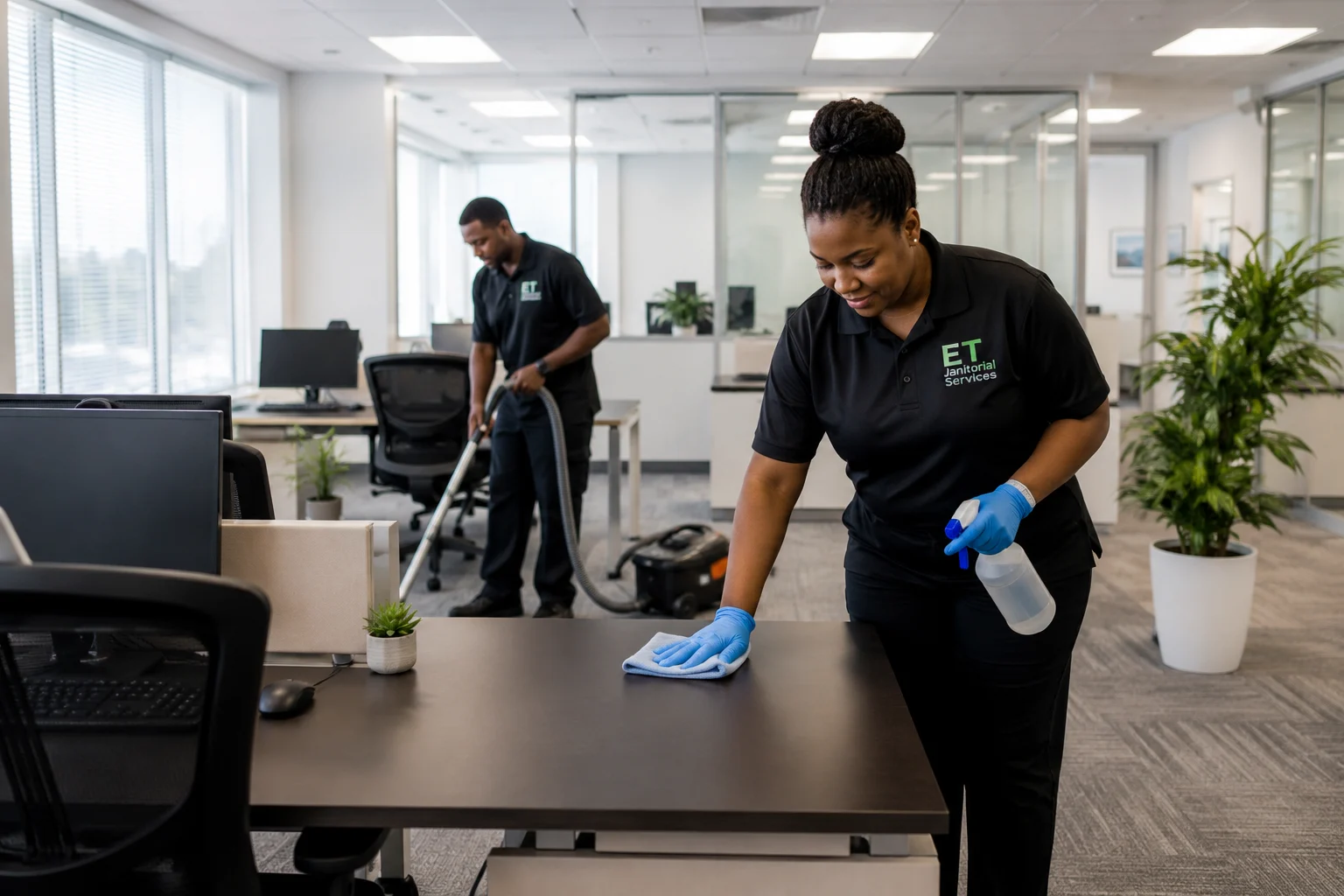
Most Jacksonville offices need professional cleaning between once and five times per week, while busy client-facing workplaces may need daily or nightly service. The right frequency depends on occupancy, foot traffic, restroom use, flooring, operating hours, and facility type. A cleaning schedule should follow how the building is actually used—not a one-size-fits-all rule.
TL;DR:
● Small, low-traffic offices may need cleaning weekly to 2–3 times per week.
● Medium or regularly occupied offices commonly need 2–5 visits per week.
● Large, busy, client-facing facilities may benefit from daily or nightly cleaning.
● Restrooms, breakrooms, entrances, and other heavily used areas often need more attention than private offices.
● Hybrid workplaces should schedule cleaning around actual occupancy and peak office days.
● Medical, dental, school, and daycare environments require facility-specific hygiene considerations.
● Carpet maintenance should be based on traffic and floor conditions rather than one universal interval.
● A professional walkthrough is the most reliable way to determine the right office cleaning schedule in Jacksonville.
Table of Contents
1: Office Cleaning Frequency by Business Type
2: What Determines How Often an Office Should Be Cleaned?
3: Restroom Cleaning Frequency
4: Daily vs. Weekly vs. Monthly Cleaning
5: How Often Should Office Carpets Be Cleaned?
6: Hybrid Work and Office Cleaning Schedules
7: Signs Your Office Is Overdue for Cleaning
8: Budget-Friendly Ways to Stay on Schedule
9: How ET Janitorial Services Sets Your Cleaning Schedule
10: Frequently Asked Questions
Office Cleaning Frequency by Business Type
There is no single answer to how often an office should be professionally cleaned. A quiet professional suite in San Marco may need a very different schedule from a high-traffic workplace in Southside with dozens of employees, visitors, shared restrooms, and breakrooms.
The following table provides practical starting points.
| Facility / Business Type | Practical Starting Frequency | Main Factors |
| Small Office, 1–10 staff | Weekly to 2–3x/week | Visitors, restrooms, food areas |
| Medium Office, 10–50 staff | 2–5x/week | Occupancy and shared-space use |
| Large Corporate Office | Daily/nightly + day porter as needed | Heavy traffic and multiple common areas |
| Law or Professional Office | 2–5x/week | Client traffic and presentation |
| Medical/Dental Office | Daily baseline in applicable patient-care areas + risk-based cleaning | Patient turnover and infection-control needs |
| Warehouse/Industrial | Daily high-traffic attention + periodic detailing | Dust, loading areas, floors |
| Retail Storefront | Daily baseline | Customers, floors, entrance glass |
| School/Daycare | Daily baseline + activity-based cleaning | Shared surfaces, meals, restrooms |
| Church/Community Hall | Around services/events; weekly may suit lightly used spaces | Worship schedule, programs, childcare |
These are starting points, not universal rules. ET’s commercial cleaning services in Jacksonville can be scheduled daily, weekly, biweekly, or on a custom frequency based on the facility.
Healthcare facilities require additional care. The CDC’s environmental cleaning guidance explains that cleaning and disinfection decisions in patient-care environments should reflect factors such as surface use, activity, contamination risk, and how frequently areas are touched.
What Determines How Often an Office Should Be Cleaned?
Staff count is useful, but it does not tell the whole story. Several factors can change an office cleaning schedule in Jacksonville significantly.
Foot traffic: A small office receiving customers throughout the day may need more frequent cleaning than a larger office with little outside traffic.
Restroom usage: Shared employee and public restrooms often determine how frequently a facility needs service.
Breakrooms: Food preparation, sinks, tables, appliances, trash, and spills create cleaning needs that private workstations may not.
Client-facing spaces: Reception areas, conference rooms, lobbies, entrance doors, and visible flooring generally need to remain presentation-ready.
Flooring: Carpet, VCT, tile, grout, and other materials require different routine and periodic maintenance.
Operating hours: A seven-day business needs a different schedule from a hybrid office occupied only a few days each week.
Facility type: A law office, warehouse, daycare, medical suite, retail store, and church should not automatically follow the same frequency.
For ordinary community facilities such as offices and businesses, the CDC recommends regular cleaning of high-touch surfaces, with other surfaces cleaned when visibly dirty.
Restroom Cleaning Frequency: High-Traffic vs. Standard
Commercial restrooms should be serviced frequently enough to remain clean, stocked, dry, and presentable throughout operating hours.
In a quieter office, a complete daily restroom service with additional checks when needed may be sufficient. In a busy public-facing facility, restroom conditions can change much faster. Checks every 2–4 hours can be a practical operational starting point for high-traffic restrooms, with immediate attention to spills, shortages, odors, or visible soil.
That interval is not a universal federal rule. OSHA requires employers to maintain sanitary restroom facilities but does not prescribe one fixed cleaning interval for every workplace. The OSHA restroom and sanitation requirements provide the relevant federal framework.
A dedicated commercial restroom cleaning service can address toilets, urinals, sinks, mirrors, floors, trash, supply levels, and odor control as part of a recurring facility plan.
Daily vs. Weekly vs. Monthly: What’s Actually Included?
The frequency of professional cleaning should also define which tasks happen at each interval.
| Frequency | Typical Cleaning Tasks |
| Daily / Each Visit | Trash removal, restroom service, breakroom surfaces, visible soil, priority floors and common areas |
| Weekly | Detailed dusting, broader vacuuming and mopping, fixtures, furniture and less-used areas |
| Monthly / Periodic | Baseboards, vents, detailed corners, carpet care, interior glass and deeper floor work |
| Quarterly / As Needed | Floor stripping/waxing, restorative carpet work, extensive glass cleaning and detailed deep cleaning |
Not every area needs the same level of attention every visit. Restrooms and trash may change quickly, while a rarely used meeting room can often be maintained on a different rotation.
Periodic work can also be separated from routine janitorial visits. Professional floor care for Jacksonville facilities, scheduled deep cleaning, and window and glass cleaning can be added when the condition of the property requires them without unnecessarily increasing the frequency of every routine task.
How Often Should Office Carpets Be Professionally Cleaned?
Office carpet should be maintained according to traffic, soil level, carpet construction, appearance standards, and manufacturer recommendations rather than a universal six- or twelve-month schedule.
Entrances, corridors, reception areas, and other heavily traveled sections generally require the most frequent vacuuming and spot treatment.
Professional deep cleaning may also need to happen more frequently in heavily used commercial areas. The Carpet and Rug Institute’s guidance for heavy and severe traffic areas describes quarterly deep cleaning for heavy traffic and monthly deep cleaning for severe traffic.
That does not mean every office carpet needs monthly extraction. A lightly used professional suite may require considerably less. The schedule should respond to actual soil and traffic patterns.
For businesses managing carpet alongside tile, VCT, grout, or other surfaces, a broader commercial floor maintenance plan can keep routine and periodic floor work on one schedule.
Does a Hybrid Work Schedule Change How Often You Need Cleaning?
Yes. A hybrid workplace should base cleaning frequency on actual in-office attendance rather than simply following a Monday-through-Friday calendar.
For example, if most employees work remotely Monday and Friday but the office is full Tuesday through Thursday, those midweek days create more restroom use, trash, food waste, conference-room traffic, and shared-desk contact.
A practical hybrid cleaning schedule can use three layers:
Baseline coverage: Trash, restrooms, breakrooms, and visible issues are handled even on lighter occupancy days.
Peak-day coverage: Shared workstations, conference rooms, entrances, kitchens, restrooms, and common spaces receive increased attention on the busiest days.
Post-peak reset: More detailed cleaning restores heavily used areas after periods of high occupancy.
Hot-desking can make this even more important because employees rotate through the same workstations and shared equipment.
The most efficient schedule therefore follows occupancy patterns, not assumptions.
Signs Your Jacksonville Office Is Overdue for Cleaning
A cleaning plan that worked six months ago may no longer match the way a business operates today.
Common warning signs include:
- Dust becomes noticeable well before the next cleaning visit.
- Restroom soap, paper towels, or toilet paper repeatedly run low.
- Trash or recycling bins regularly overflow between visits.
- Lingering odors develop in restrooms or breakrooms.
- Carpet traffic lanes or hard floors quickly look dull.
- Entrance glass becomes visibly marked during the workweek.
- Employees or customers repeatedly mention cleanliness.
- Shared kitchens and common spaces become messy before the next scheduled service.
One isolated problem does not necessarily mean the entire schedule needs changing. But when several of these issues repeatedly appear between visits, the cleaning frequency or task checklist should be reassessed.
Budget-Friendly Ways to Stay on Schedule
A cost-effective cleaning plan is not necessarily the plan with the fewest visits. It is the plan that puts cleaning time where the facility actually needs it.
A moderate-traffic office, for example, might use two or three complete cleaning visits per week while prioritizing restrooms, trash, breakrooms, entrances, and other high-use areas. Lower-use rooms can receive detailed attention less frequently.
Businesses can also control unnecessary cleaning costs by:
- Matching cleaning days to peak occupancy.
- Prioritizing fast-changing areas instead of treating every room identically.
- Separating routine janitorial tasks from periodic projects.
- Scheduling deeper floor, carpet, or glass work only when needed.
- Reviewing frequency when staffing levels or operating hours change.
The goal is to maintain the spaces employees and customers actually use without paying for repetitive work in areas that remain clean between visits.
How ET Janitorial Services Sets Your Jacksonville Cleaning Schedule
A reliable schedule should start with the facility itself.
ET Janitorial Services is a locally owned Jacksonville cleaning company serving the area since 2018. Instead of forcing every business into the same package, the cleaning process begins by understanding the facility, schedule, and required scope.
During a commercial walkthrough, important considerations can include:
- Facility size and layout
- Number of employees
- Daily visitor traffic
- Peak occupancy days
- Restroom quantity and usage
- Breakroom activity
- Floor types
- Business operating hours
- Client-facing areas
- Facility-specific cleaning requirements
- Periodic floor, glass, or deep-cleaning needs
That information is used to create a custom checklist and determine whether weekly, 2–3 times per week, daily, nightly, or another recurring schedule makes the most sense.
For Jacksonville businesses that need ongoing service, a customized commercial cleaning schedule can combine routine janitorial work with the specific areas that require the most attention.
Get the Right Cleaning Schedule for Your Jacksonville Office
Not sure whether your office needs weekly, several-times-a-week, or daily cleaning? ET Janitorial Services can assess your facility, traffic, restrooms, flooring, and operating hours to build a cleaning schedule around your actual needs.
Get a customized Jacksonville commercial cleaning plan and request your facility walkthrough and quote today.
ET Janitorial Services
3107 Spring Glen Rd Ste 208, Jacksonville, FL 32207
Call: +1 904-480-9224
Find Us On Google Maps: https://maps.app.goo.gl/z493Qx6o9auSXkqu7
Frequently Asked Questions
Q1: Can office cleaning be scheduled after business hours?
Yes. After-hours cleaning is often useful when a business wants to avoid interrupting employees, customers, meetings, or daily operations. The exact service window should be agreed upon before recurring cleaning begins.
Q2: Do employees need to leave the office while professional cleaners are working?
Not necessarily. Many routine tasks can be completed around employees, while more disruptive floor work or intensive deep cleaning may be better scheduled when the building is less occupied.
Q3: How long does a typical office cleaning visit take?
There is no universal duration. Cleaning time depends on square footage, number of restrooms, floor types, task checklist, facility condition, frequency, and the number of cleaning professionals assigned.
Q4: Can an office increase cleaning during its busiest season?
Yes. Businesses with seasonal traffic, special projects, temporary staffing increases, or peak customer periods can benefit from adjusting cleaning frequency and returning to the normal schedule afterward.
Q5: Should a business schedule cleaning before or after a major company event?
Often both serve different purposes. Pre-event cleaning prepares entrances, restrooms, floors, and gathering spaces for guests, while post-event cleaning handles increased trash, spills, food areas, and floor traffic.
Q6: What information should I have ready when requesting an office cleaning quote?
Useful details include approximate facility size, business type, number of restrooms, preferred service days, operating hours, current cleaning challenges, and any floor, glass, or periodic cleaning requirements.
Q7: Is day porter service different from regular janitorial cleaning?
Yes. A day porter typically handles visible upkeep during operating hours, such as restroom checks, spills, trash, and common areas. Scheduled janitorial cleaning usually covers a broader checklist at set times.
Q8: Can the cleaning checklist be changed after service begins?
A cleaning checklist should be reviewed when occupancy, business hours, facility use, or problem areas change. Updating the scope can be more effective than continuing a schedule that no longer matches the property.